
A Bearden collage does not behave like a JPEG.
On a screen, the edges read clean. The paper reads flat. Scale looks consistent, even when it is not. In person, the work is more stubborn. It has seams. It has weight. It has decisions you can feel in your body, especially when you stand close enough to see how a hand was cut, or how a face was assembled from sources that were never meant to meet.
That gap between “seen online” and “seen in the room” is not a small, aesthetic complaint. It is an access problem. It shapes who gets to learn from the work, who gets to teach it, and who gets to claim it as part of their own cultural inheritance.
Traveling exhibitions are one of the few practical ways to narrow that gap.
When a show travels, Bearden becomes available to people who cannot fly to New York or Washington for an afternoon of looking. The show also lands inside different local histories. Chicago hears Harlem differently than Boston does. Pittsburgh reads labor differently than Phoenix does. New Orleans hears the blues without needing footnotes.
A touring program is not just a logistics exercise. It is a way of expanding the audience with intent.

Romare Bearden's "Siren's Song" (1979) – A dynamic screenprint from the Odysseus Suite, illustrating Odysseus's encounter with the Sirens, blending classical mythology with African American cultural elements.
Why traveling exhibitions matter for education
The case for touring is partly philosophical, but it is also measurable.
A large randomized study of school tours to an art museum found increases in students’ critical thinking, historical empathy, and tolerance. It also found that students were more likely to want to return to a museum in the future. Those effects were especially strong for students from disadvantaged backgrounds.
That study focused on a single visit. Touring changes the basic equation because it makes repeat engagement plausible. A show runs for weeks or months. Faculty can assign a return visit. A student can come back with a friend. A museum educator can build a sequence instead of a one-off tour.
For smaller museums, university galleries, cultural centers, and HBCUs, touring also solves a different problem: it brings major work into spaces that are already structured around students and public learning.
What hosting can look like at a smaller institution

Slave Ship (1971)
A common misconception is that hosting a traveling exhibition requires a blockbuster building and a blockbuster budget. Sometimes it does. Often it does not.
The Foundation’s current national touring exhibition, Romare Bearden: Artist – Activist – Visionary, is designed with real-world hosting in mind: 50 works, interpretive text panels, and 200–250 linear feet of required space. It is booking through 2027 and it is managed in partnership with a professional touring organization.
That scale is substantial, but it is not absurd. It is a serious exhibition that can fit in a mid-sized museum or a university gallery with planning.
There is also a second model that works especially well for campuses and cultural centers: prints and works on paper. A print-focused show tends to travel more easily. It also plays beautifully with classroom-based learning. The Foundation has organized and toured print exhibitions before, including From Process to Print: The Graphic Works of Romare Bearden, which traveled to venues that include the Chicago Cultural Center, the Museum of the African Diaspora in San Francisco, and the August Wilson Center in Pittsburgh.
That list demonstrates a practical truth. Bearden already has a touring history that fits precisely the kinds of hosts this pipeline is meant to support.
Programming, meanwhile, does not have to be elaborate to be effective. The most successful host sites tend to add a small number of “anchor” events that pull different communities into the same room:
- one educator event with classroom-ready prompts
- one student-centered day with tours or drop-in looking
- one public talk that connects Bearden to local history
- one hands-on program that treats collage as a method, not a craft
These are modular. They scale to the size of the institution.
Case study: California, where prints become a curriculum
San Francisco is a useful example because it shows how a touring exhibition can function less like a prestige object and more like a teaching tool.
When From Process to Print reached the Museum of the African Diaspora, the exhibition included 84 prints across techniques and decades. It was explicitly framed as part of a national centennial celebration.
A print show has a particular advantage for student engagement. The medium is inherently “explainable.” You can teach it. You can connect it to process. You can ask a class to identify repetition, variation, editioning, and the way an image mutates from one technique to another.
More importantly, prints keep Bearden’s central intelligence visible. The surface is different from the collages, yet the underlying strategy remains: fragmentation and assembly, narrative built from juxtaposition, modernism used as a vehicle for Black life without apology.
A West Coast host also expands the geographic common sense of American art. Too often, students encounter a story that runs New York–Chicago–Los Angeles and it skips the rest. Touring allows Bearden to appear on the calendar of institutions that students already know, which changes what feels “central.”
That is not symbolic. It is pedagogical.
Case study: Pittsburgh, where Bearden meets the public humanities
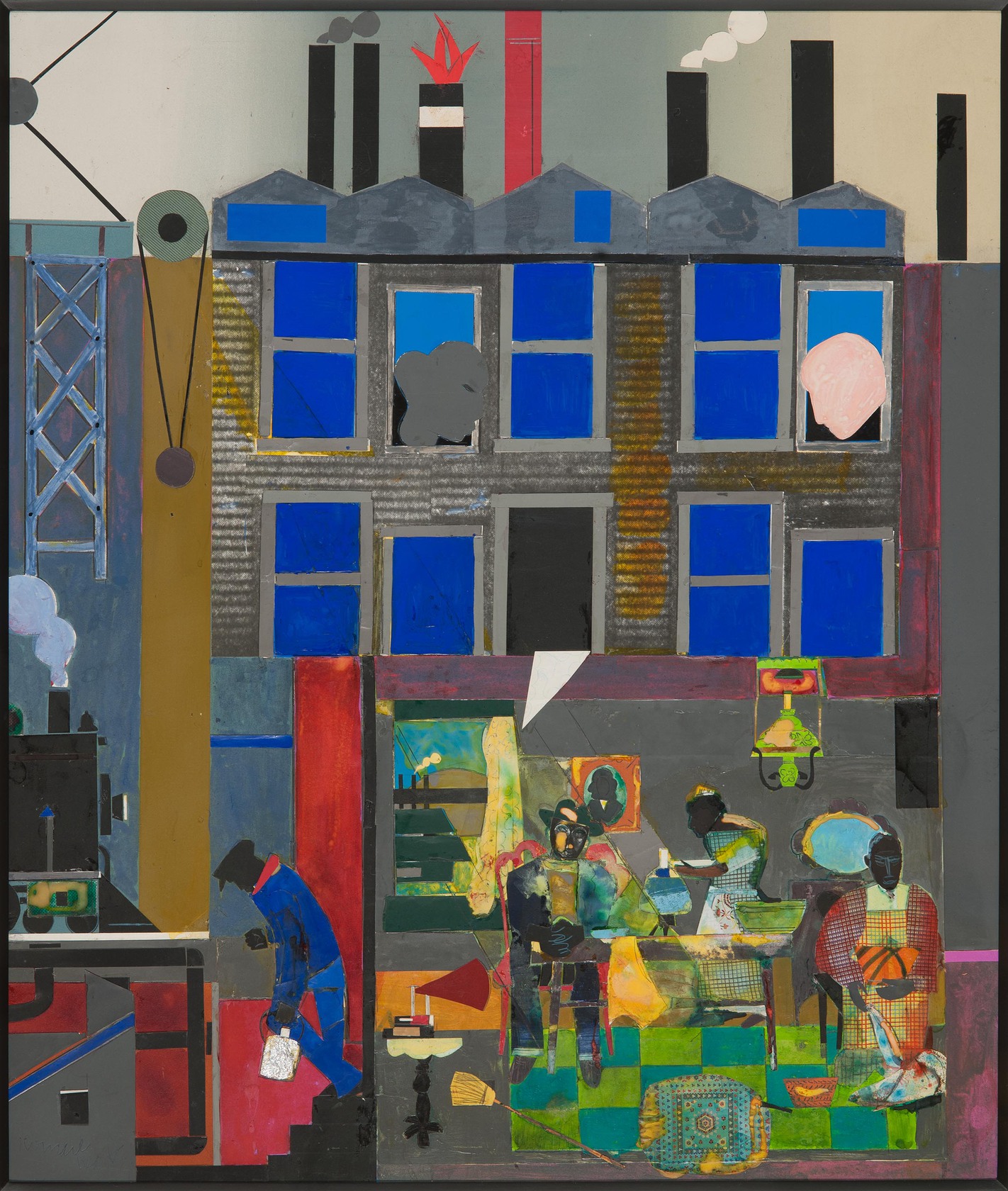
Pittsburgh Memories (1984)
Pittsburgh offers a different kind of lesson because the city is not only a tour stop. It is part of Bearden’s own formation.
The Foundation’s exhibition history records Pittsburgh hosts for Bearden projects, and it includes the August Wilson Center as a traveled-to venue for From Process to Print.
That particular host is telling. A culturally specific center tends to program differently than a general museum. It treats the exhibition as the beginning of a conversation rather than the end point.
You can see that approach in the Wilson Center’s public education programming. One workshop announcement explicitly uses Bearden as a teaching pillar. It references August Wilson’s “Four B’s” and it includes the creation of Bearden-inspired collages as part of an arts learning session tied to storytelling.
That is the touring value in its clearest form. A traveling show arrives. It activates local teaching. It becomes material for public programs that continue after the final day of the run.
Pittsburgh also illustrates a practical point for prospective hosts. You do not have to do everything alone. A university gallery can co-program with a public library. A cultural center can co-program with a music department. A small museum can partner with a local school district. Touring works best when it becomes civic rather than internal.
Chicago as proof of concept for broad public access
Civic cultural centers pull a different audience than traditional museums do. People wander in while running errands downtown. Visitors come for architecture or an event, then they stay for art. For a show built on collage, that accidental encounter is not a downside. It is the whole point. Bearden is an artist of lived public life. A public venue suits him.
For the touring pipeline, Chicago is also a reminder that “access” is not only about geography. It is also about invitation. The host’s format can widen the circle before a single teacher signs up for a tour.
Why New Orleans belongs on the tour map
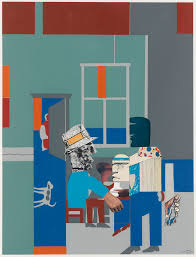
“Of the Blues: Carolina Morning” (1974)
New Orleans can be discussed in two ways at once: as a city with deep cultural resonance in Bearden’s work, and as a region where student engagement can be built through campus networks.
Bearden’s Of the Blues series includes works explicitly rooted in New Orleans musical life. One museum education resource describes New Orleans: Ragging Home as depicting a jazz band walking in the French Quarter after a funeral. It connects the series to the evolution of Black music from New Orleans street bands to Harlem jazz clubs.
That local resonance is not a decoration. It is a curatorial advantage. When the work arrives in Louisiana, audiences have reasons to lean in that are immediate and specific.
There is also proof that Bearden programming resonates in the state’s academic ecosystem. In 2019, Southern University’s Museum of Art presented a Bearden exhibition of 18 serigraphs spanning series that include “Jazz,” “Prevalence of Ritual,” and “Odysseus,” with tours explicitly encouraged.
That is the touring argument in miniature: a show lands in a student-centered institution, then it becomes a platform for teaching.
New Orleans has the additional advantage of network density. Colleges, universities, cultural centers, and arts nonprofits are already accustomed to collaborating. A touring Bearden exhibition can plug into that ecosystem quickly, especially if it arrives with a small suite of program options that institutions can adapt.
What hosting can look like in three clear tiers

Roots (1977)
For institutions considering a Bearden tour, it helps to think in tiers rather than binaries.
Tier 1: Compact print exhibition + teaching toolkit
Ideal for university galleries, cultural centers, and smaller museums. Emphasis on technique, process, and classroom use. Touring precedent exists.
Tier 2: Mid-scale survey exhibition + local partnerships
A package like Artist – Activist – Visionary brings multiple mediums and interpretive panels with defined space requirements.
Tier 3: Exhibition plus public programs
A host adds one or two signature events: an educator night, a student docent program, a jazz partnership, or a community collage workshop. This is where exhibitions stop being “visiting content” and start behaving like local civic life.
None of these require a museum to become a different institution. They require a museum to choose a level of ambition that matches its capacity.
The ask

Martin Luther King Jr. – Mountain Top (1968)
If your institution is a small museum, a university gallery, a cultural center, or an HBCU, and you are building an exhibition calendar that can serve students as well as the public, consider hosting a traveling Bearden exhibition. The current touring package is bookable through 2027, and the hosting parameters are clear enough to evaluate quickly.
If you are a reader with a campus or museum network, share this post with the person who plans exhibitions or public programs. Touring pipelines often begin that way: one forwarded link, one “have you seen this,” one conversation that turns into a date on a calendar.