
Cities teach people how to see. They teach rhythm. They teach distance. They teach what counts as private, and what gets lived in public.
Romare Bearden’s art carries that education. It carries it without postcards. It carries it without the tourist gaze. Two places matter most for this story: Harlem and Pittsburgh. One is often treated as Bearden’s mythic home. The other is sometimes treated as a detour. That framing misses what the work insists on.
Harlem and Pittsburgh are not competing settings. They are paired lessons in American urban life—shaped by migration, shaped by labor, shaped by music. Bearden learned that cities are built by collective motion. He also learned that memory is not soft. Memory is evidence.
Bearden’s own timeline makes the movement plain. His family moved to New York City in 1914. They later settled permanently in Harlem in 1920. Bearden’s timeline moves back and forth. His family moved to New York City in 1914 and settled permanently in Harlem in 1920. He also spent part of his earlier life in Pittsburgh, in Lawrenceville, where his maternal grandmother—after remarrying—ran a rooming house in a steel-mill neighborhood. He attended school there as a child. Later, his high school years were split between cities: he spent his first two years in New York (at DeWitt Clinton School annexes), then returned to Pittsburgh for his final two years at Peabody High School, graduating in 1929.
Migration is the hidden architecture
The modern American city was not only built upward. It was built northward.
The Great Migration is often described in big numbers and big decades. Bearden approaches it through objects and through routes. Trains, in particular, become a recurring fact of life and a recurring image. In one teaching resource tied to his work, trains are described as “weighted symbols.” They signify Black migration north after slavery. They also clock time, haul materials, and provide jobs.
That combination matters. Migration is never only aspiration. Migration is also logistics. It depends on rails, wages, boardinghouses, and the city’s ability to absorb new arrivals without devouring them.
Bearden’s Pittsburgh memories begin there.
Pittsburgh: labor seen from the inside
Bearden went to Pittsburgh in 1925 and later lived there with his maternal grandmother. He graduated from Peabody High School in 1929. His grandmother operated a boarding house that catered largely to steel mill workers, many of whom had recently emigrated from the South.
That boardinghouse detail does more than add texture. It explains Bearden’s vantage point. He did not have to invent “working-class life” from the outside. It was in the rooms. It was in the kitchen. It was in the bodies coming home from a shift.
A National Gallery of Art teaching packet makes the labor story even sharper. As a teenager, Bearden worked the night shift at U.S. Steel in the summer of 1927. Later, he wrote about the condition of Black workers in the steel industry. The same resource notes that his re-creations of Pittsburgh often include smokestacks, scaffolding, pulleys, and trains hauling steel.
It is easy to romanticize “industry” as an aesthetic. Bearden does not. His Pittsburgh is heat and machinery, and it is also domestic care. In the same packet, a remembered boardinghouse scene centers a warmly lit room and the routines that helped workers recover between shifts.
That is the throughline. Labor is never only the mill. Labor is also the infrastructure around the mill.
A close read: Pittsburgh Memories (1984)
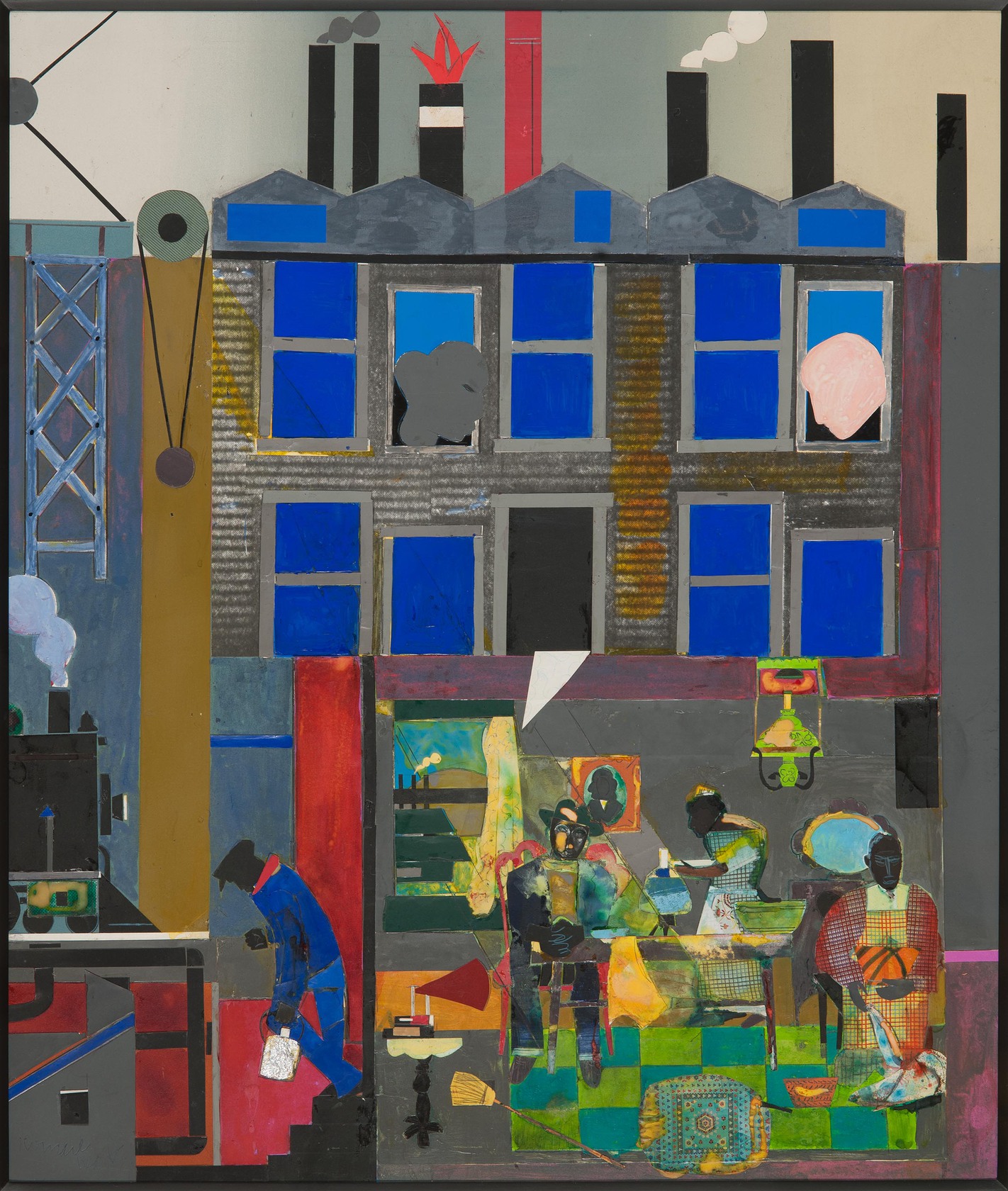
Bearden’s collage Pittsburgh Memories gathers that world into a single frame. The teaching packet that reproduces it describes the work’s materials as a layered mix of papers, fabric, foil, paint, and drawing media. It also links the imagery to the essentials Bearden observed around steel work and working-class life.
Look closely at how the image handles space. Pittsburgh is not rendered as skyline. It is rendered as pressure. You feel the weight of smoke and the geometry of industrial rigging. You also feel the pull between inside and outside. A boardinghouse is never fully private. It is a temporary home, and it is an economy.
The collage refuses one sentimental trick. It does not turn workers into symbols. It shows them as part of a system that runs through objects. Lunch buckets. Doors. Stairs. The literal tools of getting through a day.
In Bearden’s hands, the city becomes a ledger of what it cost to arrive.
Public art as civic memory: Pittsburgh Recollections (1984)
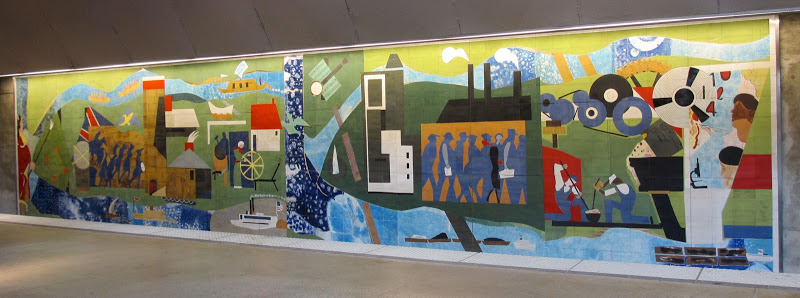
Bearden returned to Pittsburgh again through public art. The Foundation lists Pittsburgh Recollections (1984) as a ceramic tile mural composed of 780 tiles. It was made by Bennington Potters, Inc. It is located at the Gateway Center “T” Station in Pittsburgh.
The choice of site is the point. A transit station is a place built for flow. It is where workdays begin. It is where shifts end. It is where the city’s timekeeping becomes visible in bodies moving in sequence.
A museum wall asks viewers to stop. A station mural meets people in motion. Bearden understood both. He also understood what public art can do at its best. It can insist that a city’s story belongs to its residents.
Harlem: the street as a public archive
Harlem is often narrated as a cultural peak, and then a decline, and then a renaissance, and then a real estate story. Bearden refuses that cycle. He treats Harlem as lived structure.
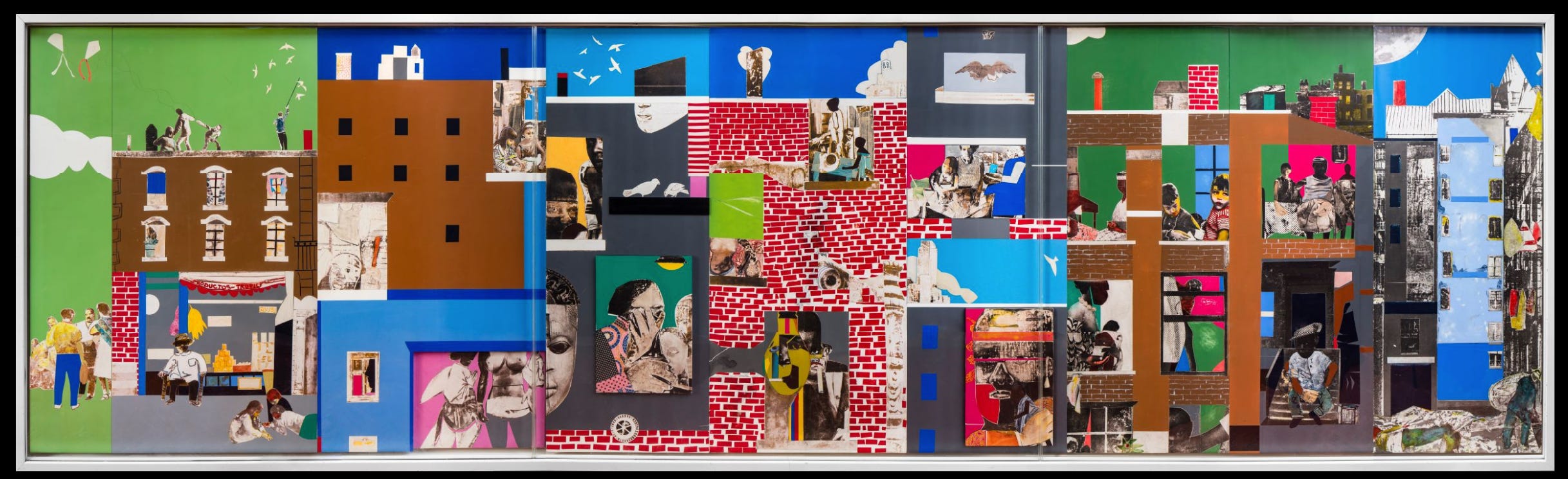
At The Metropolitan Museum of Art in New York (the Met), The Block (1971) reads as a Harlem streetscape assembled from paper. Residents gather outside apartment buildings. A barbershop, a Baptist church, and a liquor store hold the street line. Above them, the interiors open up. Private life is visible in rooms stacked over storefronts. Bearden based the architecture on Lenox Avenue between 132nd and 133rd Streets, though the scene is meant to stand for Harlem more broadly.
That description reads almost calmly. The work does not.
Bearden’s Harlem is dense. It is stacked. It is full of thresholds. Storefront becomes sidewalk. Window becomes stage. The city’s social life happens where boundaries blur.

Romare Bearden’s "The Block," a six-panel collage depicting a vibrant Harlem neighborhood, filled with everyday scenes of community life, children playing, and storefronts, embodying Bearden’s signature storytelling through collage.
A close read: The Block (1971)
The Met notes that The Block evokes not only sights, but also sounds. Traffic. Televisions blaring from open windows. Bearden once referred to the work as a “collage with sound.” An audio-tape collage accompanied The Block at its debut at MoMA in 1971. For years, that tape was effectively out of circulation. It has since been rediscovered, and it can now be heard online where the Met features The Block.
Sound matters here because it breaks the glass case of nostalgia.
A silent Harlem can be romanticized. A Harlem with televisions and street noise becomes harder to simplify. It becomes a place where public life is constant, and where private life is never fully sealed.
The Met’s essay also describes specific moments inside the image. Pallbearers carry a coffin to a hearse. Angels receive the spirit. A new mother cradles her baby. The block holds birth and death without dramatic separation.
That is the city as collective life. People live beside each other’s turning points. They absorb them. They continue.

Jazz as urban method
Jazz is not just a Bearden theme. It is a discipline of composition.
Harlem’s music scene shaped Bearden’s eye early. One National Gallery of Art resource notes Harlem’s jazz and blues clubs were nearby, including the Apollo Theatre. It adds that Bearden had a studio above the Apollo for sixteen years.
That kind of proximity does something to an artist’s sense of structure. Jazz teaches variation. It teaches return. It teaches how a group can improvise without falling apart.
Bearden’s collage practice behaves similarly. It builds coherence without sanding down difference.
A work like Jammin’ at the Savoy makes the relationship explicit. The Studio Museum in Harlem describes Bearden as heavily inspired by improvisational jazz. It notes that he layered disparate sources to build narrative. In the collage, musicians perform against wavy bands of color.
Hold that image next to The Block and the logic becomes clearer. Harlem is not only depicted. It is orchestrated. The city becomes a score written for multiple bodies.
That is also where Pittsburgh and Harlem reconnect. Steel mills and music clubs seem like separate worlds, yet they are connected by the same forces: migration, wages, crowding, and the constant need to build community fast.
Bearden’s cities are shaped by motion. The people arrive. The city changes. The city demands work. Then the city produces culture anyway.
Bearden in place
For educators and for students, three simple questions can open the work:
1) What keeps the city running in this image?
Look for institutions and routines. Shops. Churches. Boardinghouses. Stations.
2) Where does labor appear, and where does it hide?
A steel mill can be explicit. A lunch bucket can be louder.
3) What does the piece sound like?
Bearden built Harlem with sound in mind. He also built with jazz logic.
Those questions travel well. They can be used in a classroom. They can be used in a museum. They can be used at home with a laptop open.
That portability is not an accident. Bearden made work that invites repeat viewing because the city itself demands it. One pass is never enough.
Harlem holds a story of street-level ritual under pressure. Pittsburgh holds a story of industrial labor and the domestic systems built around it. Bearden does not ask viewers to choose between them. He asks viewers to notice how cities produce collective life.
The final question belongs to the reader.
What city holds your story?
Explore Bearden’s works online. Share this post with educators and students. Then keep the conversation going.