
Who Holds the Mirror?
Who defines grace and strength in Black womanhood? When Bearden painted a mother with a child or an ethereal goddess, he was doing more than making art. He was reclaiming agency—offering Black women their own visual voice in American culture.
Romare Bearden dedicated his creative genius to centering women—as caretakers, dancers, mythic figures—in a world that often silenced their stories. His portraits radiate both tenderness and authority, weaving threads of African heritage, modernism, and myth into the representation of Black womanhood.
In highlighting Bearden’s women, we illuminate an essential strand of his legacy: honoring those who nurture, create, perform, and transcend. Let’s explore how Bearden visualized women’s inner lives with nuance, depth, and power.
Mother and Child: Modern Madonna, Universal Love
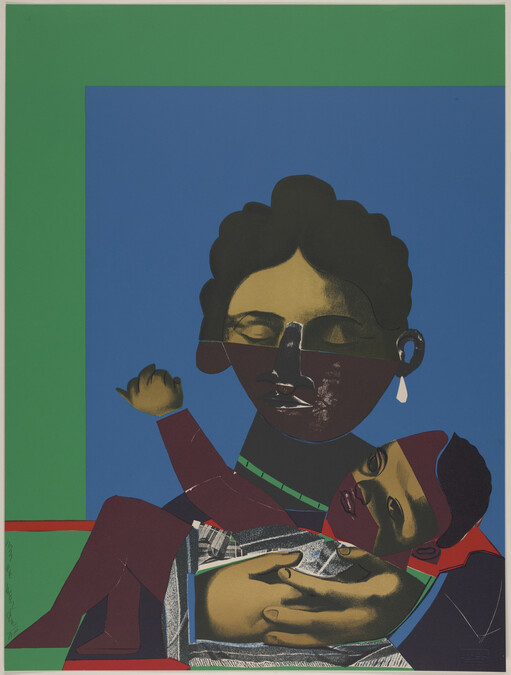
Romare Bearden, Mother and Child (1971). A modern-day Madonna portrayed with dignity and care, merging Renaissance composition with African American context.
In Mother and Child (1971), Bearden revisits one of the oldest themes in art. Caught in his layered cut-paper collage is not only maternal love—it’s a portrait of dignity. The Smithsonian American Art Museum notes that this work “echoes Renaissance depictions of the Virgin Mary holding baby Jesus” yet remains “a modern-day Madonna celebrating maternal love.”
This piece was part of a Conspiracy: The Artist as Witness portfolio supporting legal defense for the Chicago Seven, reflecting Bearden’s belief that everyday intimacy was political. By giving the mother protective hands and an alert awareness, he honors both domestic and broader social strength.
In doing so, Bearden elevates motherhood as resistant artistry—a quiet yet radical affirmation of survival and care.

Romare Bearden, Empress of the Blues, 1974. In this vibrant tribute to Bessie Smith, Bearden channels the emotional power of the blues into layered color, rhythm, and form. The work captures the grandeur of a performer and the soul of a musical tradition rooted in Black experience.
Reflected Identity: Fragment, Self, and Double Consciousness
While Mother and Child is among Bearden’s best-known depictions of women, many of his collages present women in moments of quiet interiority and introspection. Whether seated in a domestic space, pausing between musical phrases, or turning slightly away from the viewer, Bearden’s female figures often seem to be caught in moments of self-reflection—emotional, intellectual, or spiritual.
Through fragmented planes and layered imagery, Bearden renders not just bodies but states of being. These layered compositions evoke the sense of double consciousness that W.E.B. Du Bois described: the fractured self-perception of African Americans navigating identity through both their own eyes and those of a society that denies their full humanity. In Bearden’s hands, this tension becomes visual—a subtle interplay of form, color, and gesture that asks viewers to see more than what first meets the eye.
The result is a body of work that not only centers Black women but imbues them with psychological depth, complexity, and power.
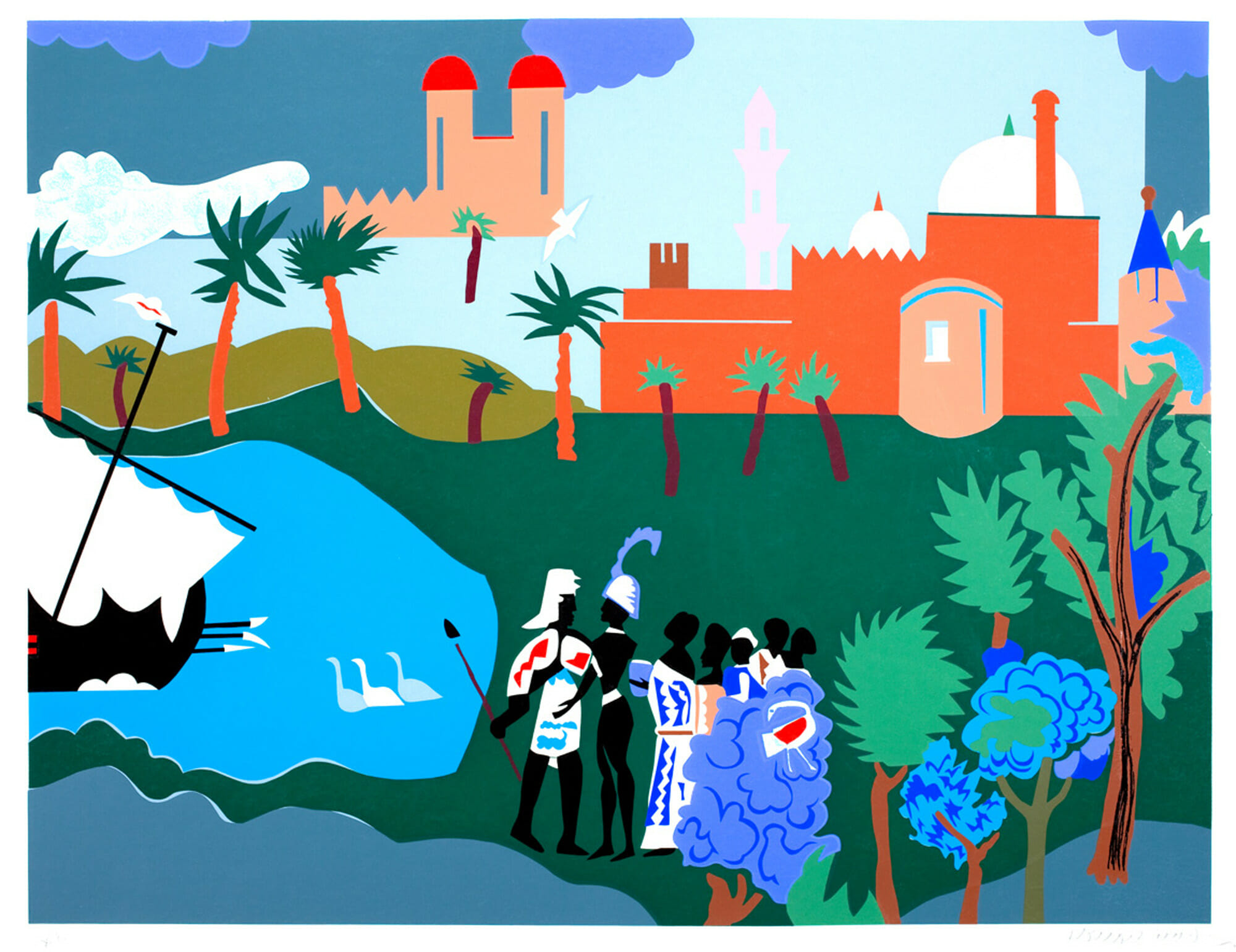
Romare Bearden, Odysseus Leaves Nausicaa (1979). A classical story reimagined through a Black aesthetic, centering Nausicaa’s grace and agency.
Odysseus Leaves Nausicaa: Mythic Grace
In Odysseus Leaves Nausicaa (1979), Bearden reclaims a pivotal female character from Homer’s Odyssey. Nausicaa, who aids Odysseus, is portrayed as serene, dignified, and decisively present—not merely an accessory to the male hero’s journey.
Bearden based this work on a 1977 collaged series and produced a screenprint edition. By casting Black figures into Greek myth, Bearden resituates women of color at the center of classical narratives. He doesn’t just retell a story—he redefines who gets to star in it.
Positioning Nausicaa in patterned robes beside stylized palm trees, he blends modernism with mythology and African visual echoes. The result is more than myth reimagined—it’s myth reclaimed.
African Lineage: Ife Masks and Goddess Figures
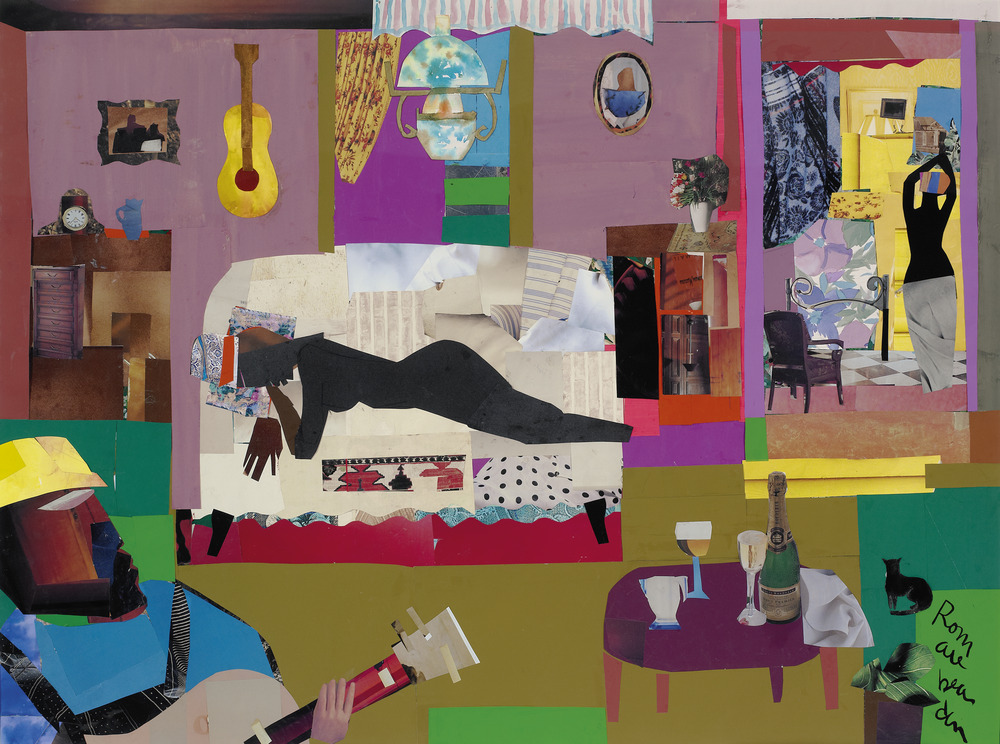
Romare Bearden, Black Venus (1968). A reconceived odalisque, reclining within a richly ornamented domestic scene that fuses African American culture with art‑historical traditions.
Bearden’s women often hint at Ife maskology and African deity traditions, drawing a visual lineage to ancestral art. Though he didn't directly copy masks, his use of stylized facial planes, bold profiles, and sculptural face construction recalls Yoruba and Ife portraiture.
Art historian Kobena Mercer has noted how Bearden’s adaptation of cubist language reflects both Afrocentric and European modernist dialogues. In pieces like Odysseus Leaves Nausicaa or his ritual-themed collages, the women’s faces feel regal—as if channeling goddesses of memory, strength, and community.
This ancestral echo enriches his portrayal of women—giving them timeless presence and spiritual authority.
Everyday Strength: Dancers, Barbershop Women, Ritual Figures
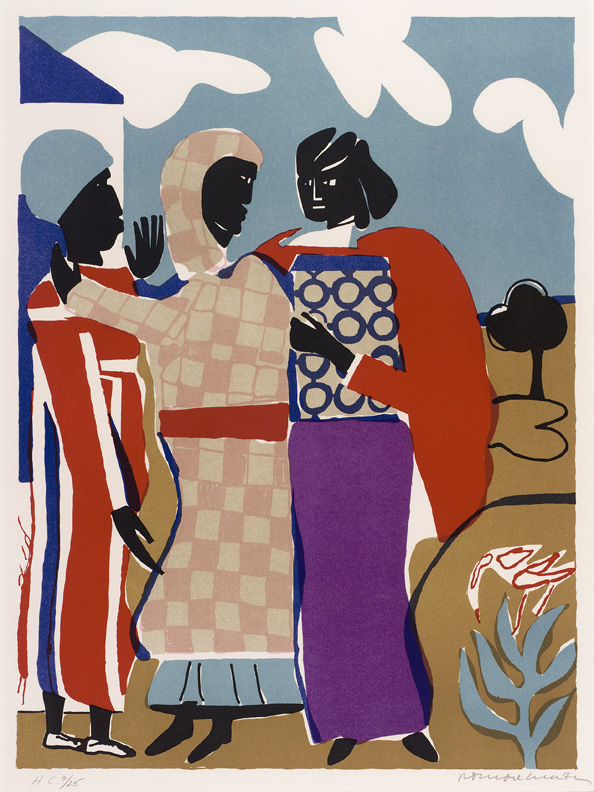
Romare Bearden, Three Women, 1975. With overlapping patterns and voices, Bearden celebrates the bond, strength, and multiplicity of Black women in community.
Not all of Bearden’s women are motherly or mythic. Some move; some style; some pray. In works featuring dancers or barbershop patrons, he depicts women as active agents—shaping their bodies and spaces.
Bearden’s dancer collages, with vibrant color and swirling forms, echo the unrestrained energy of performance. Figures carrying out domestic or ritual acts, like sewing or prayer, are shown with intense concentration. Though rooted in the routine, their gestures feel almost sacred.
Women appear both grounded and exalted—part of daily life yet part of larger cultural rhythms. In these collages, Bearden reminds us that routine labor is a form of art.
Modernist Intersections: Cubism Meets Femme Form
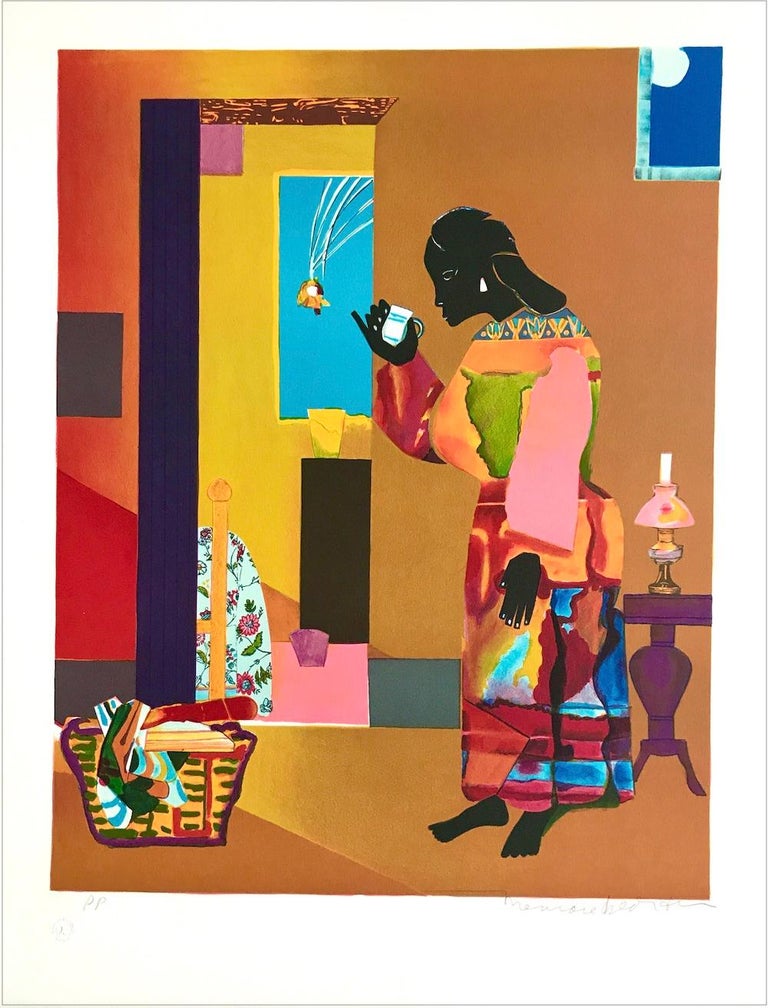
Romare Bearden, Falling Star (1979). This lithograph evokes Southern domesticity and memory—an interior scene anchored by a graceful woman and illuminated by a nocturnal star outside.
Bearden was deeply influenced by Cubism and photomontage, but his women are neither abstracted nor dehumanized. Instead, he preserves emotional resonance—eyes meet ours, curves suggest movement, hands rest consciously.
In Mother and Child, geometric sheets echo cubist planes, but they never eclipse the warmth of the embrace. In Nausicaa, flat stripes suggest classical stasis yet the woman’s gaze is fluid, intent.
This tension between modernist form and emotional connection defines Bearden’s style—inviting viewers to feel the complexity of Black womanhood through composition and surface.
Contemporary Resonance: Expanding Black Womanhood on Canvas
Bearden’s representations of women resonate with modern artists like Mickalene Thomas, who uses rhinestones to frame Black femininity, or Kehinde Wiley, who places Black women in poses of classical reverence.
These artists extend Bearden’s work by making Black women central to their own narratives. They wrestle with visibility, beauty, self-assertion—themes Bearden quietly introduced decades earlier.
Bearden turned the mundane into the sublime, the private into public artistry. That legacy informs conversations about representation today—about whose stories get told, and how.
Engage with Bearden’s Women Now
The Romare Bearden Foundation offers educational guides and virtual gallery tours focused on women-centered works. Engage with their resources:
- Explore the Foundation’s online archives featuring Mother and Child and Odysseus Leaves Nausicaa.
- Download teaching materials on Bearden’s portrayal of women—ideal for classrooms or community groups.
- Join a webinar or workshop spotlighting Bearden’s female subjects and their legacy in modern art.
These resources invite deeper reflection on how Black women claim space in visual history, through presence, poise, and portraiture.
Presence Beyond the Page
Romare Bearden’s women are not accessories. They are narrators, guardians, protagonists. Through them, he explores lineage, ritual, nurture, myth. He gives us powerful testimonials of Black womanhood—embodied, ancestral, modern.
They remind us that power isn't always loud. It can be quiet. Steady. Present. Bearden’s women stand at the crossroads of tradition and transformation. They sing, they nurture, they resist.
When we see them, we are invited to see deeper—to acknowledge strength in everyday gestures, to honor legacies, to challenge narrow visual codes. Bearden showed us that portraiture could be an act of both reverence and revelation.