

Girl in the Garden (Romare Bearden, 1979)
Spring is often treated as a season of fresh starts, but in Romare Bearden’s work, renewal is rarely simple. It is not innocence. It is not erasure. It is not the fantasy of beginning again untouched by what came before.
It is memory returning in color.
Again and again, Bearden came back to gardens, porches, yards, and cultivated outdoor spaces: places where life is tended, where time gathers, where the ordinary world becomes charged with ritual, intimacy, and story. In works like In the Garden, Maudell Sleet’s Magic Garden, Maudell Sleet’s July Garden, and Spring Fever, growth is never only botanical. It is emotional. Cultural. Generational. The garden is not merely scenery. It is a keeper of memory.
That feels especially resonant in spring, when the world insists on motion. Buds appear. Light changes. Air softens. What looked dormant reveals itself as living after all.
Bearden understood that kind of return.
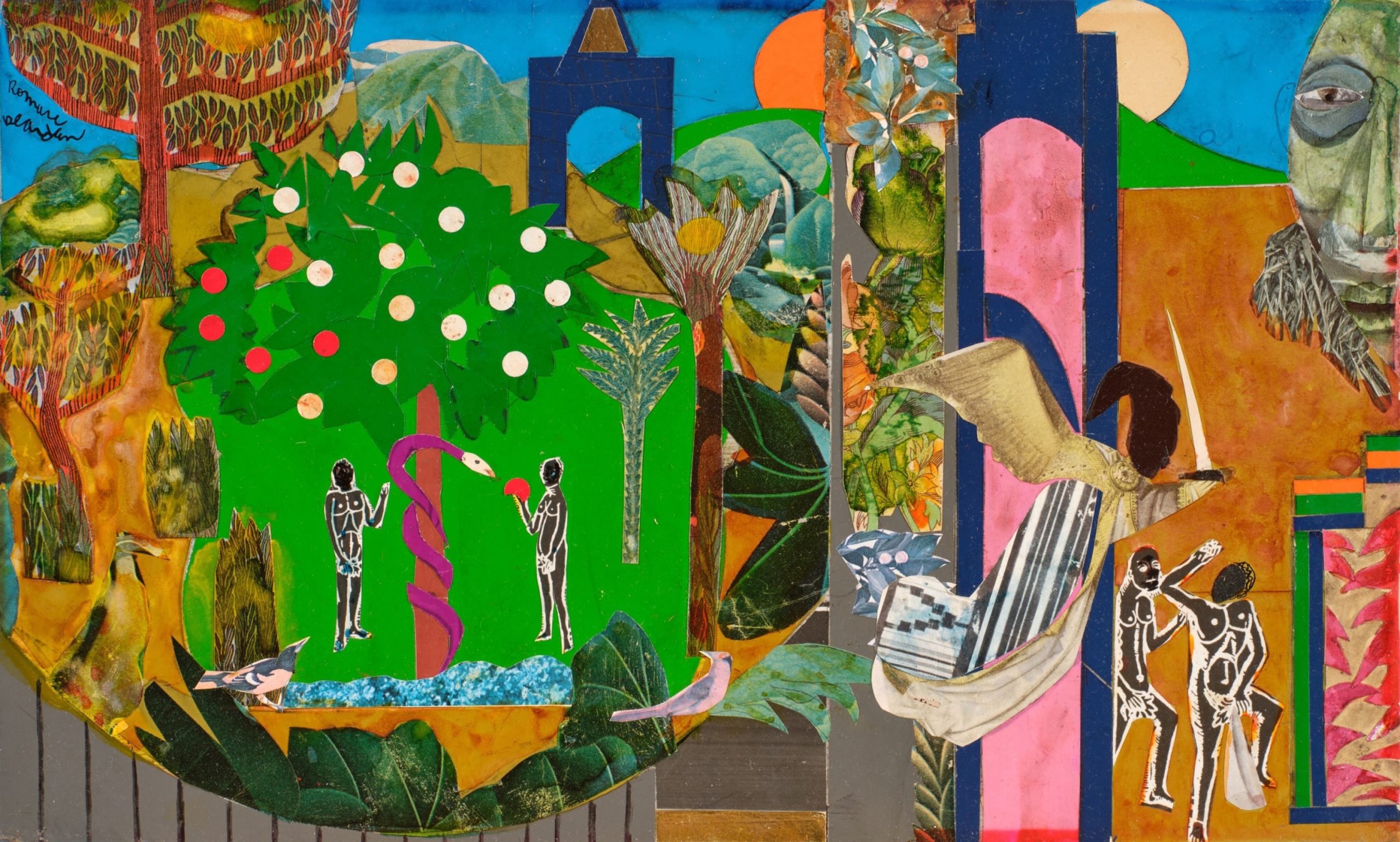
Profile/Part I, The Twenties: Mecklenburg County, Expulsion from Paradise (Romare Bearden, 1978)
In 1978, throughout the spring and early fall, he created the twenty-eight-collage series Profile/Part I: The Twenties, based on memories from his childhood in Mecklenburg County. It is work shaped by time, remembrance, and the act of going back—not nostalgically, but to see more clearly. Bearden reflected on the need to “go back where you started,” and singled out “my great-grandfather’s garden” among the impressions that stayed with him.
That is a powerful idea for spring: not reinvention, but return with deeper sight.
In Bearden’s hands, the garden becomes a place where the past is not static. It grows. It rearranges itself. It comes forward in fragments—color, gesture, pattern, memory, atmosphere—and becomes newly legible. One of the great powers of collage is that it does not pretend experience arrives to us in one smooth piece. It arrives in flashes, shards, echoes, scraps. A face remembered differently over time. A season recalled by its heat or shade. A place reconstructed through feeling as much as fact.
That is part of what makes the garden works so moving. They are not simply pretty. They are alive with recollection.
Bearden described figures like Maudell Sleet as people he was “recalling,” not rendering as fixed, documentary likenesses. Memory, in this body of work, is not a filing system. It is an act of imaginative care.
And care is, in many ways, what a garden asks of us.

Romare Bearden, Maudell Sleet’s Magic Garden, 1978. Collage on board. Collection of Pearson C. Cummin III and Linda Forrest Cummin.
Not instant transformation. Not spectacle. Attention. Stewardship. Repetition. Faith that what is planted, protected, studied, and nourished will continue to grow.
That is also what legacy asks.
The work of the Romare Bearden Foundation is rooted in exactly that kind of care. The Foundation celebrates Bearden’s legacy not as a sealed historical achievement, but as a living body of work that still has something urgent to say. Through exhibitions, public programs, research, educational initiatives, and the Digital Catalogue Raisonné project, the Foundation helps make Bearden’s art accessible to scholars, students, artists, and the broader public. It also continues his commitment to supporting artists and intellectual inquiry in the present.
That matters because legacy can easily be flattened. A great artist becomes a name. A name becomes an image. An image becomes a citation. The living force of the work gets reduced to familiarity.
Bearden resists that reduction.
His art is too restless, too layered, too full of motion between times and places. He was not only a collagist, but an artist, educator, writer, organizer, and institution builder. The Foundation’s own framing of his legacy emphasizes that breadth: Bearden as artist, scholar, social activist, and cultural force whose work continues to inspire contemporary artists and audiences.
To keep that legacy alive requires more than admiration. It requires infrastructure. Archives must be preserved and activated. Scholarship must be encouraged. Programs must be produced. Context must be built. New generations must be invited in.
In other words: the garden must be tended.
That is the spirit behind this season’s Spring Appeal, In Bloom.

Romare Bearden, Maudell Sleet's July Garden, 1985. Mixed media collage.
The phrase is meant to evoke more than springtime beauty. It speaks to the ongoing work of helping Bearden’s legacy remain visible, meaningful, and in motion. A legacy blooms when people can encounter it. When students can learn from it. When scholars can deepen public knowledge around it. When artists can enter into conversation with it. When the public can see, hear, and feel that this work belongs not only to history, but to the living present.
Bearden’s gardens show us that growth is not abstract. It happens somewhere. It happens because something has been cared for long enough to become abundant.
This spring, we invite you to help sustain that care.
A gift to the Romare Bearden Foundation supports the work that keeps this legacy alive: educational initiatives, public programs, research, scholarship, and expanded access to Bearden’s world. It helps ensure that the work does not simply survive, but continues to reach outward—to bloom in classrooms, exhibitions, archives, conversations, and imaginations still forming.
That is one of the deepest lessons in Bearden’s art: the past is not gone. It waits to be re-seen, reassembled, and carried forward.
And sometimes it returns to us like a garden in spring—familiar, changed, and suddenly full again.